
Problem? An analysis of Anthropic's latest brand campaign.
Let's pause to unpack it.

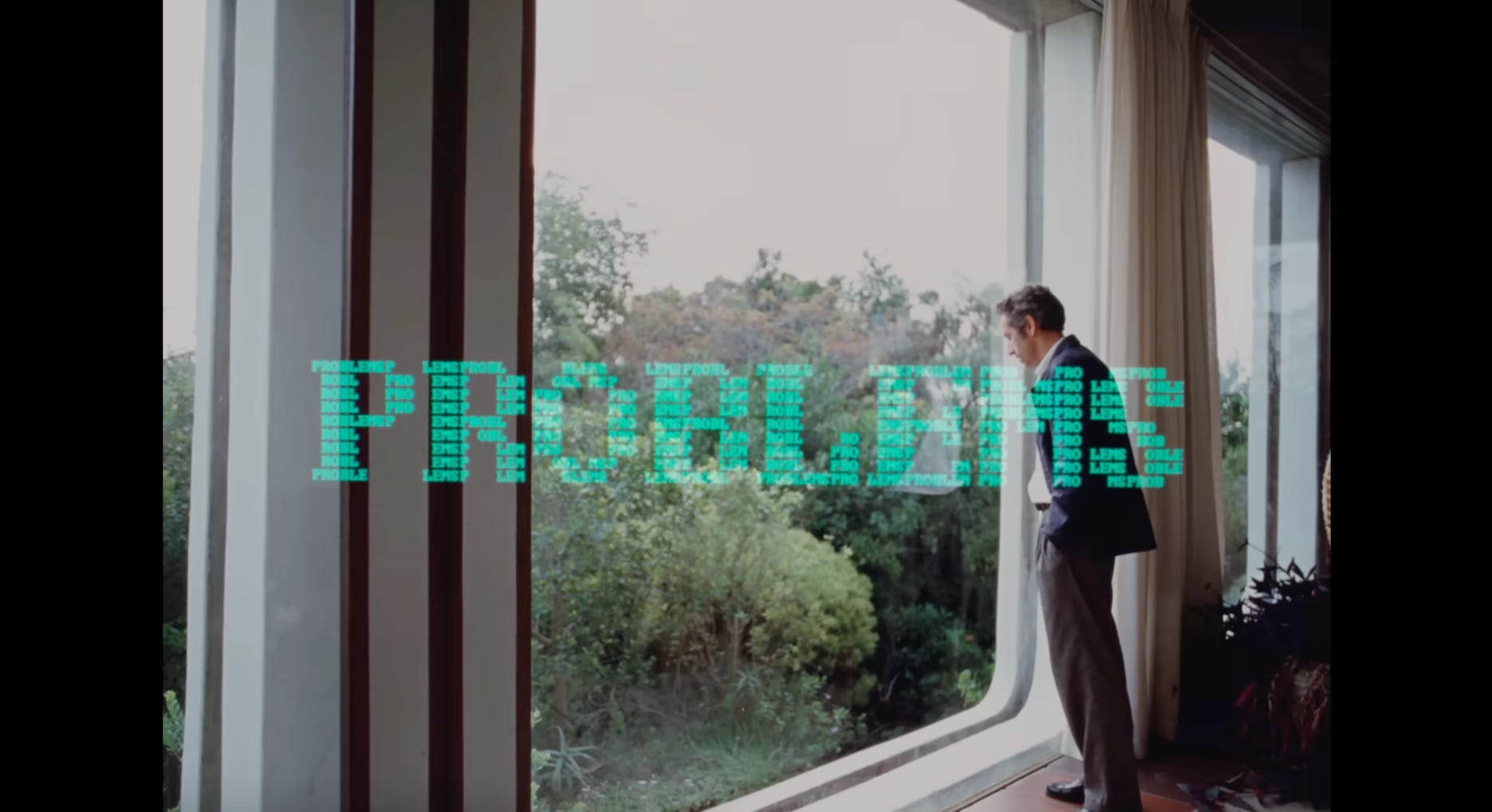
Anthropic launched a nostalgic and oddly hopeful definition of how they intend Claude to be used, and it’s all packaged in a gorgeously cinematic launch video.
So, let’s take a dive into their use of language, image, and form.
[Anthropic’s ‘Keep thinking’ campaign, created by Mother.]
There’s never been a worse time.
It’s not a common intro for a brand campaign. The start of Anthropic’s video is Orwellian. A robotic refrain, ‘problem’, is regurgitated amidst the sound of sirens. Each clip expresses a problem, and the problems are accompanied by failed attempts to write or visualise the word: a pencil breaks, a typewriter misses out the letters. This trap replays on a loop for the first few seconds. Problems are presented as inescapable, somewhat repressing, and almost catastrophic. Between the sirens, the failed solutions, and the broken processes, there’s an urgency that these things need fixing.
We’re constantly confronted by problems, whether they’re from our own ‘echo chamber of intrusive thoughts’, or they’re simply part of our world. The real problem begins when you can’t solve them.
The first frames of the video intertwine human and robotic scenes. They’re disorientating, flitting between close-ups, zoom-ins, details, and bigger pictures. Many are fleeting allusions to contemporary disasters: power outages, environmental disasters, medical emergencies, destruction.
These first few scenes also feel a little like scrolling on social media. We’re forced through a feed of disparate emotional experiences, whether we’re conscious of it or not: a Zara Larsson meme, a video of a shark in an aquarium, a news flash of an earthquake that’s killed thousands. Day to day, we’re confronted with a lot, all at once, and this sentiment accumulates in Anthropic’s intro too. The problems are blurry, there are many of them, they’re being left unsolved.
In the campaign, this conceptual slippage towards catastrophe culminates in a grand piano dropping from a multi-story building. One of the prior frames shows a gentleman attempting to fix a piano’s hammers and strings, and this image of remedy is quickly overshadowed when the piano crashes to the ground, and the scene cuts.
There are lots of quick allusions to untangle in the intro, but one that’s pertinent is what the piano might represent.
Pianos symbolise artistry, refinement, individual expression, and profound emotion. More recently, they could also be considered a symbol of nostalgia, creativity, memory, and artistic longing. For example, if we look at what how music is defined to us now, and how we create it, we find that even its category is blurry. Music creation can now, if we want, happen through software, and we can generate it in just a couple of prompts. Rather than being the product of practice, dedication, and handiwork, the symbol is migrating. We’re at risk of dispensing of these kinds of artistry and the craft they hold, in exchange for software generated art. It’s a binary view that fits neatly into Claude’s positioning as a ‘AI thinking partner’, rather than a replacement.
It’s apt that the first phase of Anthropic’s video closes by destroying this time-transcending symbol of human expression. Walter Pater theorised that ‘all art constantly aspires to the condition of music’, that it is abstractly the purest form of human art, and it’s this same message that is symbolically subsumed when the piano falls. A piano contains a perfect state of art: tactility, performance, sound, mechanism, engineering, emotion, memory. As an object, it’s a product of both science and art — one created it, one keeps it alive. I’m not sure what Mother intended exactly through this opener, but if musical instruments are considered an extension of the body to those at the peak of their craft, I’d hazard a guess that they want Claude to be perceived in a similar way.
There’s never been a better time to have a problem.
Redemption and solution are weaved more into the narrative at the end of the intro. When the scene of the fallen piano rewinds, the first frames of Claude are integrated within scenes of human craft.
Whereas before, problems were occurring in isolation, suddenly every frame becomes collaborative. Humans are working with others on their challenges, problems suddenly feel expansive, rather than suffocating, and technology is at the centre of these acts of problem-solving - aiding, rather than usurping them.
Universe closed use rainbow.
Discovery and possibility become the video’s new conceptual refrain.
Human art: music, dance, sketches - are represented dynamically , aided and accelerated by the technology that AI is enabling.
We’re prompted to ‘Keep’ creating, researching, coding, thinking.
We don’t often stop to notice the difference that the gerund form of verbs makes in our speech, but Anthropic’s use of it in their campaign message is in itself expansive. The gerund presents action as an activity or concept, suggests the action is ongoing, and turns this concept into a general abstraction. By using it in the campaign, thinking and creating are encouraged to continue alongside AI, rather than being offloaded through it.
Technology infiltrates every aspect of the campaign, but it’s depicted as overlaying human problem-solving, rather than being an intrusion.
So, what about it?
Anthropic’s video is one of the first to flip the AI narrative, depicting it as an enabler of collaboration, aid, support, and creation, instead of a replacement.
AI has made a lot of us a bit glass-half-empty, which I think is why Anthropic’s campaign is capturing attention in the first place. Instead of being an animation or motion video, it’s more like cinematic film.
It mixes nostalgia, creation, and technology - three things that are often presented in conflict, and instead positions them in collaboration for the good of solving the world’s problems.
I hope by unpicking some of the nuances of this campaign that you’ve found some delight in its detail - it really is a clever piece of cultural commentary, and I adore how it’s been composed!
Their campaign encourages us to rethink the technological hierarchy that we’ve been working with, presenting a vision in which human problems are more quickly and technically solved with help from AI, instead of fomenting the fear that everything will, at some point, be dripped in AI slop.